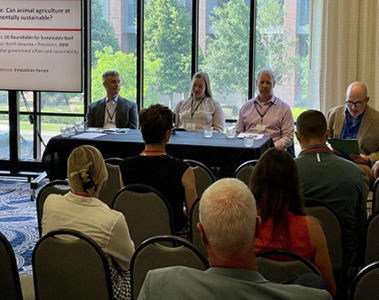
At September’s Poultry Sustainability & Welfare Summit organized by the US Roundtable for Sustainable Poultry & Eggs and the International Poultry Welfare Association, David Dayhoff, dsm-firmenich Animal Nutrition & Health’s North America Director of Sustainability and Precision Services, moderated a panel discussion about cross-protein collaboration when it comes to sustainability & welfare. Sometimes when all the different agriculture groups collaborate, they are collectively called “The Barnyard.” This event was a great opportunity to bring together representatives from the US Poultry & Egg Association, the National Pork Board, the US Roundtable for Sustainable Beef, The Meat Institute, IFEEDER and the North American Renderers Association.
While there are some distinct differences between sustainability aspects, for example, of ruminants versus monogastrics, or feed ingredients that are also part of the biofuels industry, there are also many opportunities in common. Panelists and the audience explored opportunities for The Barnyard to amplify its collective voice and influence.
The panel covered a lot of ground, but a few of the key ideas covered included:
Feed: the environmental footprint of feed makes up the majority of the footprint of animal proteins, even in the case of beef and dairy with forage/grazing and enteric methane. All of the animal proteins have a common opportunity in looking at feed sustainability and technologies. Related, also to different degrees, circularity of feed ingredients—such as creation and use of rendered products, co-products or food and other wastes—all play an important part in feed and ultimately the proteins’ footprints.
Efficiency: Efficiency is the heart of all the proteins’ sustainability stories. The improvements in efficiency enabled not only through feed conversion and more efficient use of resources, but also productivity, morbidity and mortality benefits from better health and welfare, are a story that all proteins can tell in common.
Measurement and Reporting: Regardless of the type of protein, in the end members of The Barnyard have to respond to common customers in retail and food service, and not just for telling each individual protein’s or company’s own story. By seeking collaboration in terms of measurement methodologies, sustainability & welfare categories and even vocabulary, all the proteins can help each other build more awareness with common customers and respond to them more effectively and efficiently.
At dsm-firmenich Animal Nutrition & Health, we are committed to the purpose of feeding the planet without costing the Earth, together with customers across feed and animal agriculture. If you would like to learn more about how our products and services and experiences can help your company with its own sustainability and welfare initiatives, please reach out to David at david.dayhoff@dsm-firmenich.com.