

Transmisión by Aparalius (Catalina Giacaman and Juan Pérez)
Aparalius, the duo formed by Catalina Giacaman and Juan Pérez, develops a practice rooted in research and experimentation, creating sculptural and sonic devices that function as modes of communication with non-human agents of the landscape. Their work seeks to establish relational fields where natural phenomena are not represented, but engaged as active participants.
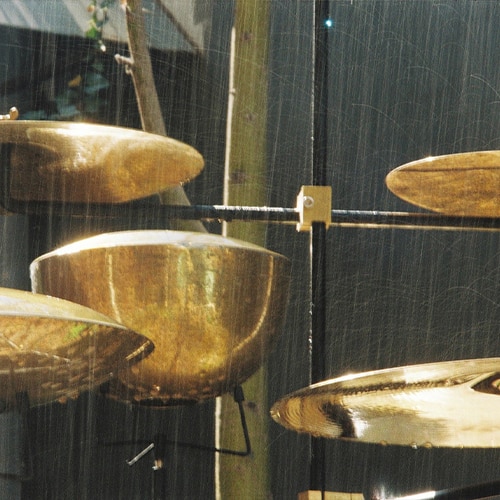
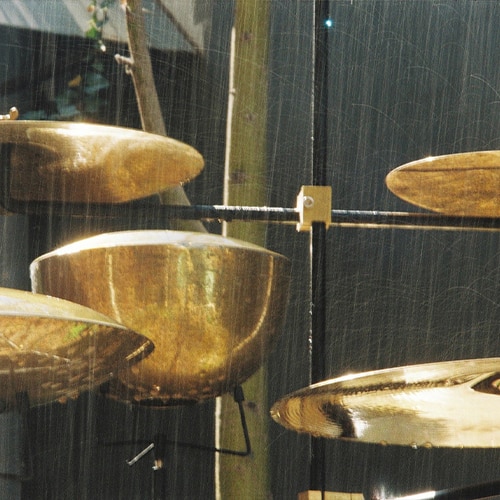
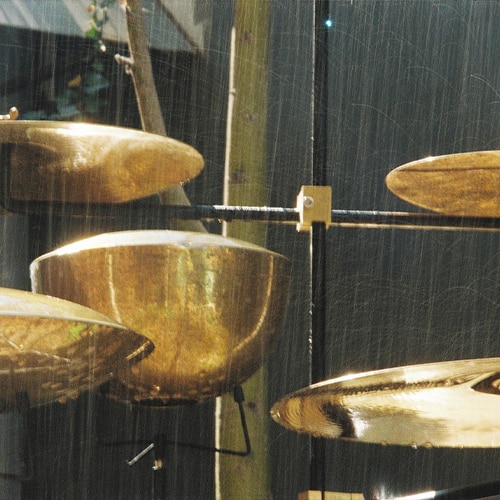
Transmisión emerges from this approach as a sculptural sound apparatus activated by rain.
A vertical metal structure supports cymbals arranged at different heights, forming a resonant body open to its surroundings. Each raindrop becomes a point of contact, its impact amplified into a layered sonic composition that unfolds in real time. The work does not impose form onto nature, but instead creates the conditions for rain to reveal its own rhythms and structures.
Developed within the project Aparatos de Observación Pluvial (AOP) in Panguipulli, Chile, the piece extends beyond observation into interaction. A custom system recreates rainfall when needed, using a misting mechanism, condensation mesh, and a recirculating water system. This generates not only sound, but also a humid atmosphere and the subtle scent of rain, enveloping the installation in a multisensory field.
Sustainability is embedded through this cyclical and situated logic. Water is continuously reused, and the work operates through minimal technological intervention, foregrounding natural processes rather than extracting from them. The installation reflects an approach grounded in coexistence, where listening, attention, and responsiveness replace control.
Through this immersive and sensory experience, Transmisión proposes a form of progress rooted in deepened relationships — between human perception, material systems, and the living dynamics of the environment.
×
About Aparalius (Catalina Giacaman and Juan Pérez)
Aparalius is a Chilean duo formed by Catalina Giacaman and Juan Pérez. Their work focuses on research, reflection, and the creation of works that function as means of communication with non-human agencies of the landscape. In this sense, their methodology is based on placing material and poetic questions in space, allowing them to gradually connect with the agencies they address.
Through this process, they seek both to establish conversations or fields of connection with them and to transform the landscape into a workshop or laboratory where it becomes possible to investigate feelings and ideas. These agential cuts, which, like conversations, interweave the fabric of our projects, ultimately become sculptural, interactive, or sound-based apparatuses that function as an approach to phenomena and as an attempt to communicate with them.

“Rather than representing rain, the work proposes a mode of relating to it: a situated practice activated through listening, perception, and shared experience. In this sense, progress is not conceived as isolated technological advancement, but as a deepening of the relationships between human beings, landscape, and natural phenomena. The project recognizes art as a bridge between human and non-human worlds, a sensitive interface that allows rain to be experienced as a living presence.”
Aparalius (Catalina Giacaman and Juan Pérez)


×
×
×
Check out other finalists’ artwork
-
-
Nénette
-
Fungyo