





Meet the Nutritional Services Team

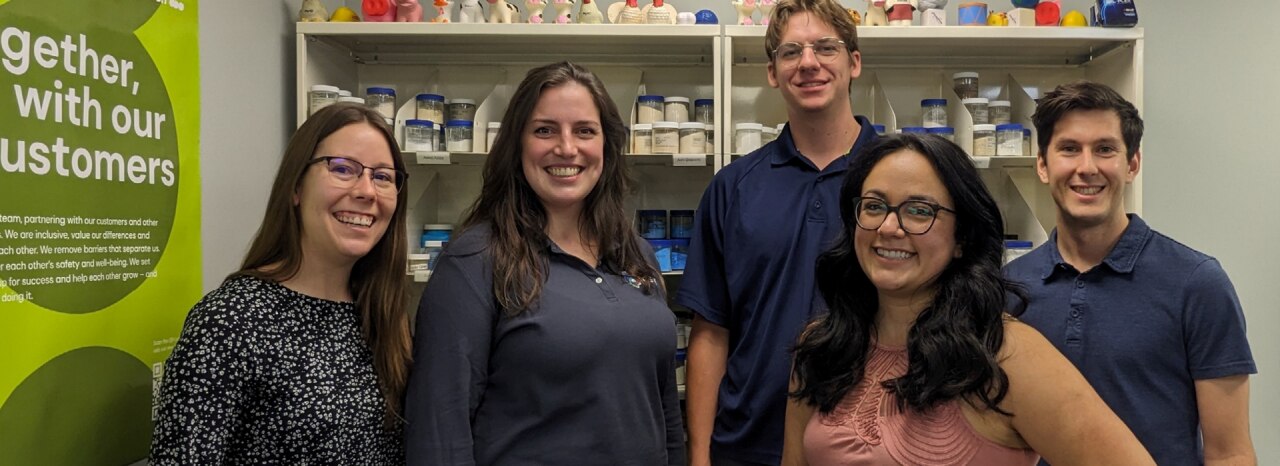
Meet our North America Nutritional Services team. Located in the Ayr, Ontario Premix plant, this team has close to 30 years experience in custom premix formulation. Key areas of customer support include formulation and label development for animal nutrition premixes. The team also supports the premix plant operations through regulatory compliance, development of ingredient specifications, approval of new ingredients, NIR, and quality monitoring of ingredients and finished goods.

Diane Elliott, MSc., Nutritional Services Manager

Diane has been with dsm-firmenich for 8.5 years in the Nutritional Services department and has been the Nutritional Services Manager since January 2023. Diane is responsible for creating and approving local and regional procedures, managing projects and supporting strategic decisions for ANH North America. Diane supports the blend plant’s compliance initiatives related to safety, health and environmental (SHE) requirements for premixes/raw materials and regulatory affairs for Canada which includes registration of products, CFIA inspections and premix labeling.

Diane holds a MSc. in Animal Nutrition (2014), specializing in Dairy Cow Nutrition, from the University of Guelph, Canada. 

Sarah James, MSc., Senior Nutritional Services Specialist

Sarah has been with dsm-firmenich for 15 years and is currently the Senior Nutritional Services Specialist. An expert on Rovimix vitamins and third-party products, Sarah is responsible for Key Account and Technical Services formulations, focusing on new product implementations. 

Sarah holds a MSc. in Animal Nutrition (2008), specializing in Poultry Nutrition, from the University of Guelph, Canada. 

Lauren Finlay, MSc., Nutritional Services Specialist

Lauren has been with dsm-firmenich for 4.5 years in the Nutritional Services department as a Nutritional Services Specialist. She is responsible for formulations, premix labelling, and specializes in third party ingredient approval.  In the ingredient assessment role, Lauren interacts with Purchasing, Supply Chain, and Premix Production to ensure that ingredients are suitable for intended use and that any associated risks are considered.

Lauren holds a MSc. in Animal Nutrition (2022), specializing in Beef Cow Nutrition from the University of Guelph, Canada. 

Nick Genova, MSc., Nutritional Services Specialist

Nick has been with dsm-firmenich for 1.5 years in the Nutritional Services department as a Nutritional Services Specialist. He is responsible for formulations, labelling, and is the NIR expert for ANH North America. Nick specializes in pet nutrition, and he is responsible for all Pet Premix accounts. 

Nick holds a MSc. in Animal Nutrition (2018), specializing in Companion Animal Nutrition, from the University of Guelph, Canada. 

Pauline Kosmal, Ph.D., Nutritional Services Intern

Pauline has been with dsm-firmenich since March 2023 as a Nutritional Services department Intern. She graduated with her PhD in Animal Biosciences (2023) from the University of Guelph and holds an MSc. as well. Currently, she is an appointed postdoctoral fellow at the University of Guelph under the advisement of Dr. Anna Kate Shoveller (BSc, PhD) studying the effects of dietary polyphenols on companion animals. She brings a unique knowledge of exotic animal nutrition to the Nutritional Services Team. 

Sam Maaskant, BSc., Nutritional Services Intern

Sam has been with dsm-firmenich since May 2023 as a Nutritional Services department Intern. He has graduated with his BSc. in Agriculture (2023) from the University of Guelph. He plans to start his MSc. in Animal Biosciences at the University of Guelph in January 2024. He specializes in premix sample manufacture and premix/ingredient lab analysis. 

Published on

23 October 2023

Tags

  • Poultry
  • Swine
  • Ruminants
  • Aquaculture
  • Premixes

Not all products are available in all markets nor associated claims allowed in all regions (including but not limited to USA and Canada).

Related Articles

  • From Testing to Prevention: Building Confidence Through Risk-Based Quality Management

    From Testing to Prevention: Building Confidence Through Risk-Based Quality Management

    20 Jul 2026

    Modern feed industry quality management has shifted from relying solely on finished-product testing to a proactive, risk-based approach focused on prevention. Manufacturers build quality into every stage of production through supplier qualification, ingredient verification, process controls, equipment maintenance, and data-driven monitoring. Industry standards such as FAMI-QS, ISO 9001, FSMA, and Canadian Feeds Regulations support this preventive philosophy. By identifying and addressing potential issues early, companies improve product consistency, regulatory compliance, operational efficiency, and traceability. Ultimately, effective quality systems reduce variability, strengthen customer confidence, and ensure safe, reliable premixes are produced consistently.

  • Beating the heat: protecting vitamin premix stability this summer

    Beating the heat: protecting vitamin premix stability this summer

    18 May 2026

    With summer fast approaching, heat and humidity pose significant threats to vitamin premix stability in animal feed production. Vitamins such as K3, A, B12, folic acid, and choline are especially vulnerable, as moisture and heat accelerate oxidation and can cause clumping, reducing potency and flowability. To combat this, dsm-firmenich offers spray-dried and beadlet product forms with protective coatings, formulation constraints on reactive ingredients, and recommends storing premixes away from direct sunlight and in ambient conditions.

  • Deviation Reduction Through Quality Culture

    Deviation Reduction Through Quality Culture

    20 Apr 2026

    A strong quality culture reduces deviations by embedding shared values and behaviors that emphasize doing things right the first time. When quality is part of everyday work, employees follow procedures more carefully and take proactive ownership to prevent errors. Open communication and accountability encourage early reporting of issues, allowing problems to be addressed before they escalate. Continuous training and improvement further strengthen processes, shifting organizations from reactive to preventive operations and enhancing overall performance.