News
November 27, 2026

As sugar reduction becomes more ambitious, the formulation challenge moves beyond sweetness intensity. At deeper reduction, the sweetener system has more work to do, while sweetness becomes only one part of the work.
Over the past two decades, food and beverage innovation has also moved toward more protein, more fiber, and stronger functional positioning. Consumers increasingly expect products to deliver several benefits at once: less sugar, better nutrition, a credible label, and an enjoyable experience.
That combination changes the formulation challenge. Depending on the source, concentration, and processing, protein can introduce bitterness, astringency, dryness, or other characteristic off-notes. Fiber can alter body, texture, and flavor release. Vitamins, botanicals, and other functional ingredients may bring additional taste challenges. At the same time, removing more sugar reduces the sweetness, flavor support, and mouthfeel that helped keep those characteristics in balance.
The sweetener system is being asked to do more, precisely when sweetness becomes only part of the problem. This is why deeper sugar reduction cannot be approached simply by matching sucrose intensity. Developers need to understand how sweetness unfolds, what else becomes more perceptible when sugar is removed, and how an integrated system can address sweetness timing, taste balance, flavor expression and mouthfeel together.
The deeper the sugar reduction, the more the sweetener system needs to do.
Sugar reduction remains one of the clearest dietary ambitions. In the 2025 dsm-firmenich ChangeLENZ study, 46% of consumers across 22 countries strongly considered reducing their sugar intake. Concern is also translating into action: 35% said they were concerned or very concerned about sugar and were reducing or eliminating it, up from 27% in 2021.
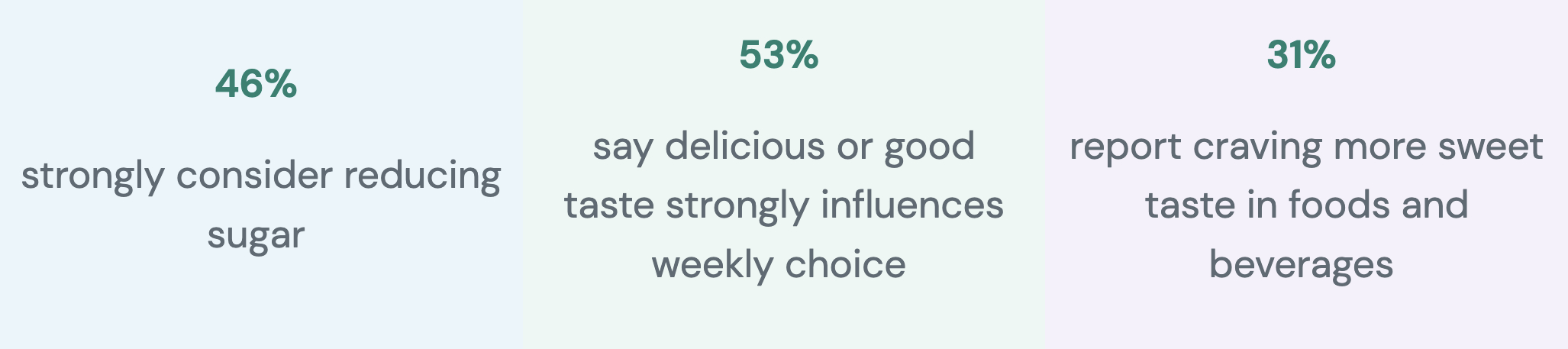
Consumers may want less sugar. They still expect sweetness to support enjoyment, indulgence or refreshment. The formulation challenge is therefore not simply to remove sugar successfully. It is to preserve the right product experience while changing how that experience is created.
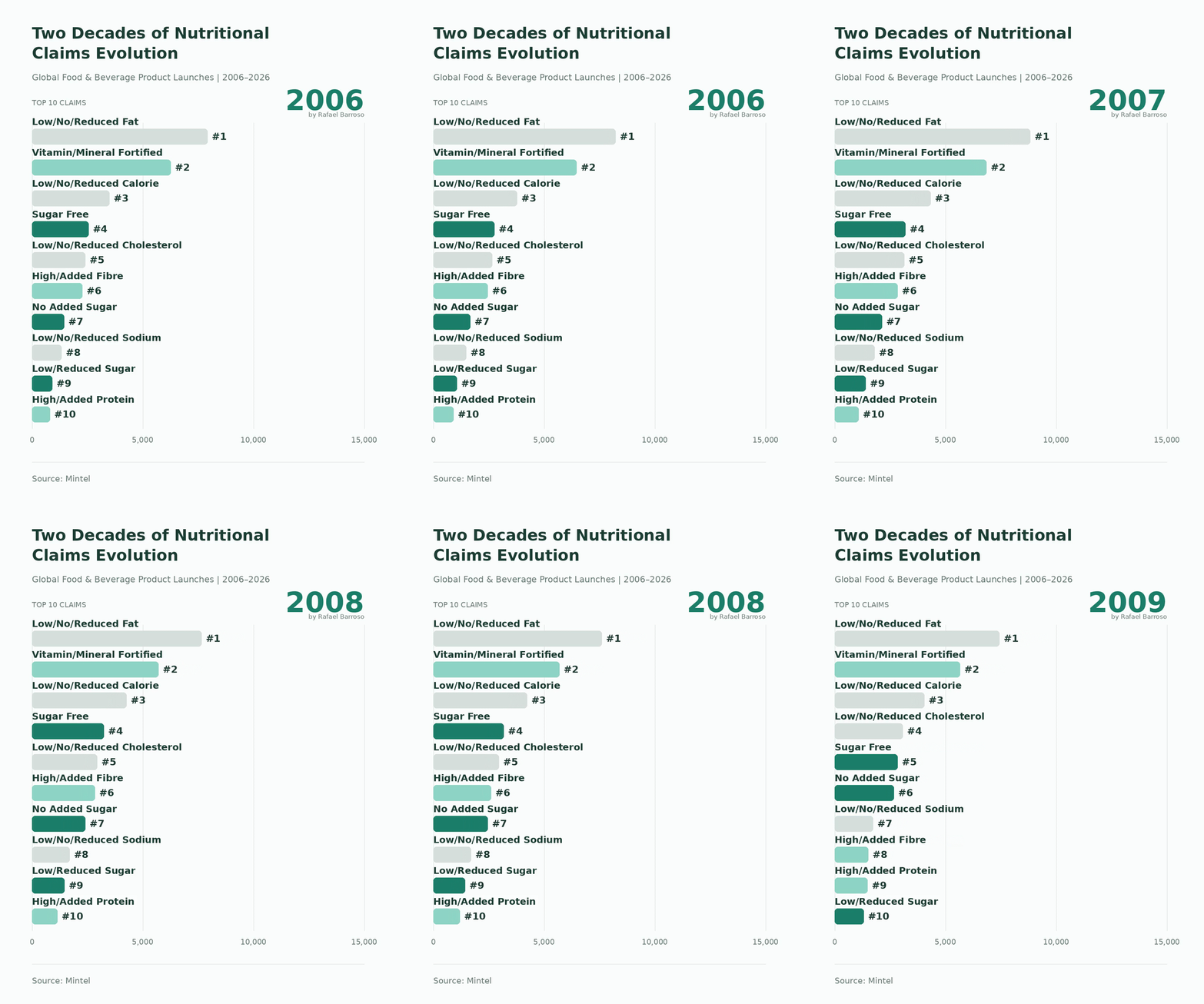
Euromonitor forecasts and Mintel launch activity show that Low-Sugar, No-Added Sugar and No-Sugar products will remain relevant. The important message is not which claim will win. It is that increasingly ambitious sugar-reduction targets remain commercially relevant, and every step deeper can change more than the sweetness level.
Sugar remains a useful benchmark because consumers understand the experience it creates. Its sweetness appears quickly, builds in a familiar way and generally recedes with the rest of the product. Sugar can also support flavor perception, soften acidity and bitterness, and contribute to mouthfeel, body, texture and even appearance, depending on the application.

At moderate reduction, residual sugar continues to perform some of those jobs, so targeted taste modulation may be sufficient to close the remaining gap. As more sugar is removed, less of that support remains and the need for an integrated sweetening system becomes greater.
In a carbonated beverage, sweetness may persist after the flavor and carbonation have faded, leaving a less refreshing finish. In an energy drink, caffeine, minerals, vitamins and botanicals can become more prominent. In dairy, acidity and flavor expression may shift. In protein-enriched products, bitterness, astringency and dryness may become harder to manage.
Fiber creates another layer. Depending on its type and use level, it can alter viscosity, texture, flavor release, and the perception of body. A formulation that reduces sugar while adding protein or fiber is not addressing each nutritional objective in isolation. Each change can affect how the others are perceived.

This is where sweetness intensity becomes an incomplete measure of success. A prototype can reach the same approximate peak sweetness as the benchmark and still feel noticeably different. Sweetness may arrive too late, remain too long or sit out of step with the characterizing flavor. Increasing sweetener dosage alone does not solve those challenges.
The product does not necessarily need more sweetness. It may need sweetness to behave differently.
High-intensity sweeteners have distinct temporal and sensory profiles. They do not all rise, peak and decline like sucrose, and their performance can change with concentration, source, purity and the product matrix.
This matters because consumers experience the full sequence, not one intensity measurement. Upfront sweetness shapes the first impression. Peak intensity needs to align with acidity, aroma, and flavor. The decline affects the finish. Lingering sweetness, bitterness, or characteristic off-notes may become more apparent after the main flavor has faded. Repeated consumption adds another consideration: the next sip or bite may begin before sensations from the previous one have returned to baseline.
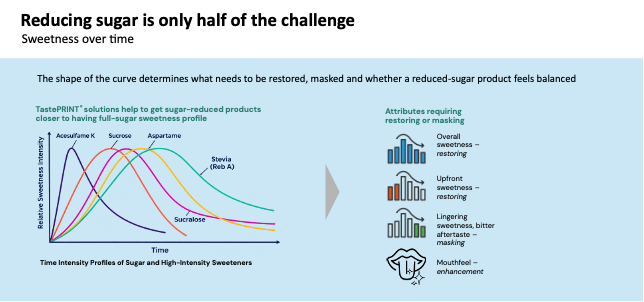
Sensory science helps translate these differences into formulation direction. Dose-response work shows how sweetness and related taste perceptions change with concentration. Quantitative Descriptive Analysis provides a static profile of the product across the relevant sensory attributes. Temporal methods add the dimension that a static profile cannot capture: Time-Intensity (TI) follows the intensity of a selected descriptor over time; Temporal Dominance of Sensations (TDS) identifies which sensation is dominant at each moment; and Temporal Check-All-That-Apply (TCATA) records which attributes are perceived at each point as the experience unfolds. Together, these methods show how much is perceived, when it is perceived, and what else changes in the product.
The value is a more precise formulation response. If the onset is weak, the system may need stronger upfront sweetness. If the peak is appropriate but the finish lingers, adding more sweetener could make the imbalance worse. If fruit or brown-flavor notes have lost intensity or authenticity, the next intervention may belong to flavor. If a product is watery, acidic, or astringent, sweetness intensity alone will not restore the experience.
AromaSphere™ Sweet supports this work by giving teams and customers a common sensory language for sweeteners and sweet-related product perceptions.
The framework looks beyond sweetness intensity across six dimensions: temporal attributes, aroma and flavor, taste, mouthfeel, trigeminal sensations, and lingering perception. It helps teams discuss the complete experience from the first perception in the mouth through the sensations that remain after consumption.
Its value is practical. Rather than describing a prototype broadly as artificial, unbalanced or “not sugar-like,” the development team can clarify where the difference occurs and which sensory dimension needs attention. That sharper diagnosis can then guide sweetener selection, taste modulation, flavor work and application development.

The sweetener name shapes expectations before the product is tasted.
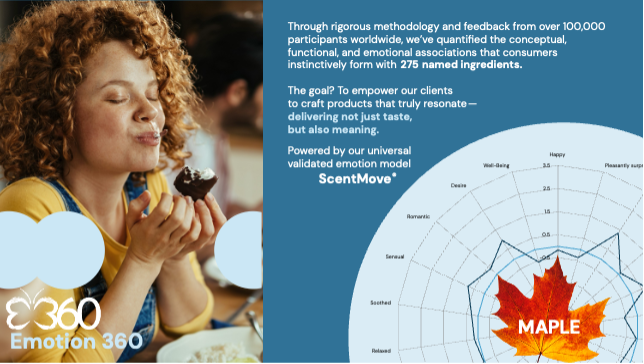
In dsm-firmenich’s global Emotion360 research, sugar reached almost universal awareness, as expected. Stevia reached 80% awareness and 28% taste familiarity. Sucralose recorded 79% awareness but only 13% taste familiarity, while monk fruit reached 59% awareness and 14% taste familiarity.
Consumers may therefore recognize the sweetener without having a well-established reference for its taste. The ingredient name can already signal naturalness, wellness, familiarity, modernity or indulgence. These are consumer associations, not evidence of health or physiological effects, but they influence how the product is approached and what consumers expect it to deliver.
Sugar retains powerful associations with familiarity, indulgence, comfort and tradition. Stevia has developed stronger associations with wellness, natural origin and modernity. Among consumers aware of it, monk fruit has a differentiated profile linked with authenticity, uniqueness, interest and premium value.
The formulation therefore needs to work at two levels: conceptually on the label and sensorially in the product. Label strategy cannot repair poor sensory performance. Sensory performance alone may not resolve a mismatch with the intended positioning.
For deeper sugar reduction, the challenge extends beyond choosing a better sweetener. The formulation may need to shape upfront, peak and lingering sweetness while also managing bitterness or other off-notes, supporting the characterizing flavor and rebuilding mouthfeel. These elements need to be designed together in the actual product, which is why integrated sweetening solutions become increasingly important as more sugar is removed.
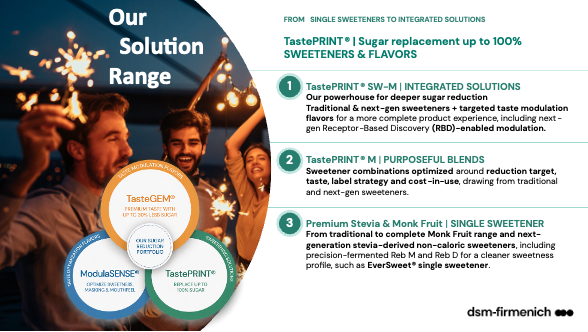
TastePRINT® integrated solutions are dsm-firmenich’s powerhouse for deeper sugar reduction. The range combines traditional or next-generation sweeteners with targeted taste-modulation flavors for a more complete product experience, including Receptor-Based Discovery-enabled modulation where relevant.
The focus is integration with a defined purpose. Sweetener architecture establishes the required sweetening profile. Taste modulation can help adjust sweetness timing, manage lingering, and address bitterness, metallic, licorice, or other unwanted notes. Flavor expertise supports intensity, character, and harmony. Mouthfeel solutions can help where sugar removal has left the product less rounded or satisfying.
Bringing these capabilities into the same brief also matters commercially. The intended label, regulatory requirements, cost-in-use, sourcing, process, and shelf-life requirements influence which technical route is viable. This is especially relevant when sugar reduction forms part of a wider reformulation. A high-protein beverage, fiber-enriched dairy product, or functional drink may need the system to manage the sensory consequences of sugar removal and the added nutritional ingredients at the same time.
No sweetener system should be judged only in water or against an isolated sweetness target. The solution needs to work in the actual product matrix, through the intended process and shelf life. Protein, fat, acids, minerals, fiber, carbonation and flavor all influence the result.
dsm-firmenich’s holistic approach therefore starts with the product and customer brief: the benchmark, consumer, reduction ambition, intended experience, label, market, process, and cost. Success then needs to be defined as a complete product experience, going beyond sweetness equivalence to the temporal sweetness profile, flavor tonality, the management of off-notes, mouthfeel, and category expectations.
Sweetener expertise, sweetness management, sensory science, flavor creation, taste modulation, application development, consumer understanding, and regulatory guidance need to connect around that same brief. The final formulation must be prototyped and validated where consumers will experience it: in the real application.
The question is not simply how far sugar can be reduced. It is how much of the product experience the sweetener system will need to rebuild as the reduction goes deeper.