
News
June 1, 2026
What Bovaer actually does on working farms: from methane reduction to an additional source of revenue. There is a question every farmer asks before trying something new in the ration: will this change how my cows perform? After this 2 years large-scale field monitoring programme with Bovaer, farmers can be confident on their herd performance.
The programme ran from early 2023 to the end of 2024, involving 17 farms across France and Poland, covering a combined total of more than 1,480 dairy cows. It was led by Savencia, the French dairy processor, with technical support from a multi-partner research and advisory consortium. Bovaer was integrated into existing farm rations, and periods with and without supplementation were alternated throughout, giving a clear, paired picture of what changed and what did not.
| Metric | France (10 farms) | Poland (7 farms) |
|---|---|---|
| Number of dairy cows / farm (avg.) | 94 | 78 |
| Main Rotation | Majority maize silage | Majority maize silage |
| Average dry matter intake (kg/day) | 23.4 kg | 23.9 kg |
| Milk production (PL, kg/day) | 29.8 | 30.6 |
| Methane emissions (baseline) | 493 g/day | 483 g/day |
The performance data is unambiguous. Across all 17 farms in France and Poland, adding Bovaer to the ration produced no measurable change in milk yield or dry matter intake. Both stayed effectively flat between supplemented and unsupplemented periods, with milk yield shifting by just +1% and feed intake by -1%. Those figures sit comfortably within normal day-to-day variation on any commercial dairy farm.
The chart below makes the point visually. Dry matter intake and milk yield are identical with and without Bovaer. The cows ate the same amount, produced the same milk volume, and similar fat and protein contents (see p.12 of the report).

Dry matter intake (left) and milk yield (right) for the combined France and Poland groups, comparing periods with and without Bovaer.
On herd health, the picture is equally reassuring. Farmers observed no changes to condition, behaviour, or wellbeing. The cows were the same animals throughout.
For the French farms in the programme, the feed margin, the difference between milk revenue and feed cost, averaged 8.08 euros per cow per day in 2023 and grew to 8.33 in 2024, with a peak of 9.23 euros in autumn 2024. That improvement reflected better forage quality across the sector in 2024.
Bovaer cost is systematically covered by dairy processors or through national subsidy plans. For farms participating in sustainability programs that reward methane reduction, the financial case is even stronger, with processor premiums providing additional revenue.
A recent XXLait article offers a detailed analysis of the economics of Bovaer use under the most common farming practices in France.
Simple to integrate into existing farm routines
Proven safe and effective through real-world farm use
Doesn’t affect productivity
No impact on milk yield, productivity, or milk quality
Supported by sustainability incentives, including dairy processors, milk collectors, and governments
Proven to reduce milk’s carbon footprint by ~10–15% immediately
Aligned with sustainability frameworks, including Scope 3 emissions reporting
Seamless integration into the milk sourcing chain without additional investment
Proven safe and effective, with regulatory approval in 70+ countries and global commercial use
"Easy to implement."
"We know the climate challenge is real, and we are glad to be part of an innovation being tested in the field."
These are verbatim responses from working farmers who spent two years supplementing their herds and tracking what happened. The consistency of the message across France and Poland is itself a finding: straightforward to use, no impact on the animals, and a genuine sense of contributing to something that matters.
A previous study from IDELE in France confirmed that Bovaer can be implemented easily on dairy farms under real-life conditions. It explored different feeding systems and delivery methods to establish guidelines for on farm implementation.

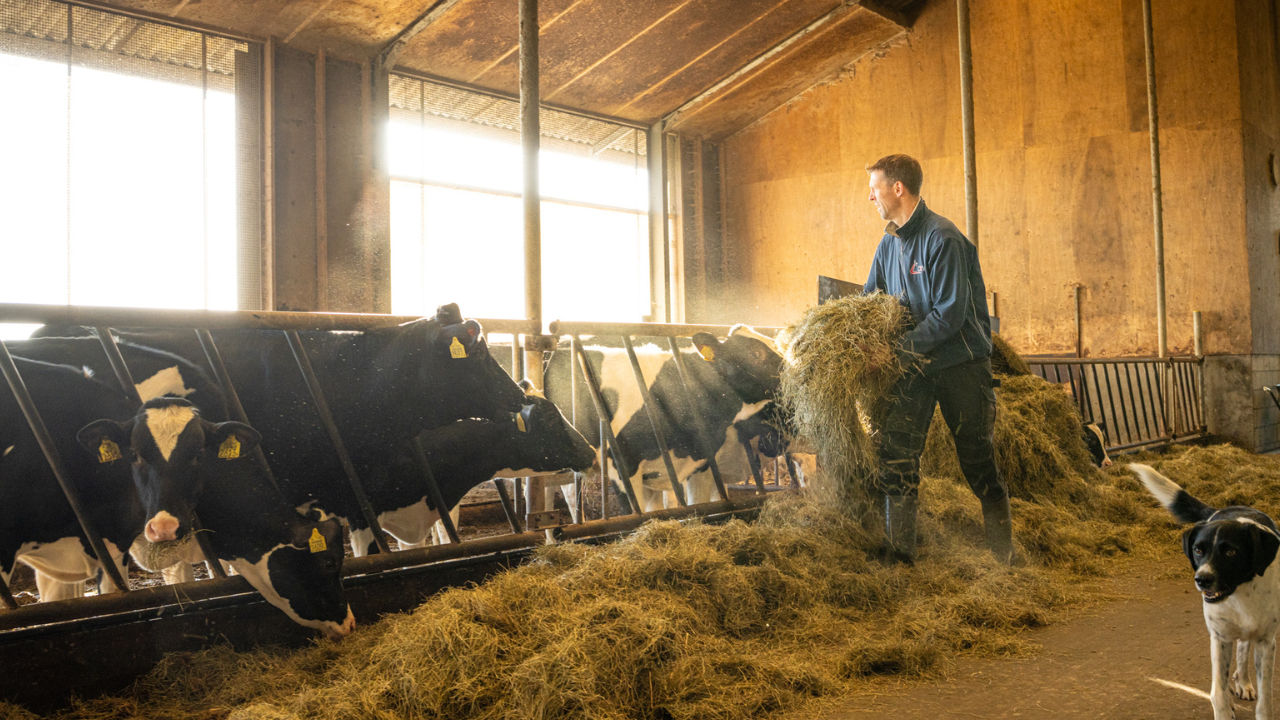
Florian runs a 70 cow dairy farm with a Simmental herd, combining modern technology with pasture based farming. Since taking over the farm from the previous generation, Florian has invested in a new building and a milking robot (installed in 2022), increasing the herd from 45 to 70 cows and boosting annual milk production from 350,000 to 600,000 litres.
The cows produce on average 28 kg of milk per day and have access to pasture day and night from spring to autumn, alongside a balanced mixed ration at the barn. As part of a continuous improvement approach, Florian is actively working on productivity, animal health, and reducing the carbon footprint of the farm.
Methane reduction is already well documented for Bovaer across more than 130 farm trials globally. This programme adds confirmation under real French and Polish conditions. In France the average reduction was 31% of daily emissions. In Poland, 33%. In both cases the effect was visible immediately when supplementation began and reversed when it stopped.

France: daily methane emissions during supplemented months (blue) and unsupplemented months (red), alongside average milk yield (line), January 2023 to December 2024. The reduction is immediate and consistent. Milk yield is unaffected throughout.
The variation between individual farms is also informative. In France, reductions ranged from 25% to 38% depending on ration composition, with maize-silage-heavy diets tending toward stronger results. In Poland the range was tighter, from 30% to 37%, reflecting the greater consistency of feeding practices across that group.
The farms in this programme ran predominantly maize-silage-based rations. Bovaer is already being used successfully across a range of farming systems, including farms with grazing up to six hours per day, where ILVO research confirmed the same methane reduction as with a full indoor ration. For farms with more intensive grazing systems, guidance on implementation across different feeding contexts is available separately.
Seventeen farms. Two countries. Two years. Same herd performance. Same milk. Additional revenue through processor premiums. And around 30% of daily methane emissions went down.
That is what large-scale, real-world farm monitoring looks like, on working farms, through changing seasons, with consistent results. For farmers considering Bovaer, this programme is the closest thing to asking a neighbour who has already tried it, across two countries, for two years, and got the same answer.